Gerry Rafferty - A Memorial


GERRY RAFFERTY AND "BAKER STREET"
By Michael Collins Morton


The untimely passing of Gerry Rafferty at the age of sixty-three, during the first week of 2011, provided a sad end to an uneasy life. Although the Scottish singer and songwriter, who was born in Paisley, Scotland, in 1947 and is best known for his hit, "Baker Street," seemed too young to depart from this world, he apparently had suffered too much from the ill effects of his stubborn alcoholism to remain here any longer. As his final years ran their awkward course, with reports of his frequent drunkenness appearing in the press, it became clear that even the undoubted strength of his abilities as a musician could not save him from the harm and pain of his private difficulties.

Gerry Rafferty stepped into the musical limelight in the early 1970s, first as a member of The Humblebums (along with Billy Connolly, a fellow Scotsman whose name also became well-known in later years), and then with Stealers Wheel (whose single, "Stuck in the Middle with You," was a hit in 1973), but it was "Baker Street," an unforgettable song inspired by the city of London and released as a single under his own name in 1978, that changed his fate forever, bringing worldwide fame and a great deal of money. Unfortunately, the arrival of fame and money did not appear to result in true happiness for him. He soon chose to withdraw from the burdensome duties of being a celebrated musician, frequently seeking to hide himself in the unhealthy realm of alcohol.

The next time you happen to encounter the poignant strains of "Baker Street," a durable track that still receives regular airplay on the radio, spare a few moments to remember the melancholy spirit of Gerry Rafferty, the gifted man who wrote it and performed it. In spite of the deep problems that weighed upon him throughout his life and finally dragged him down, his distinct talent and honest expressiveness enabled him to reach into himself and pull forth a heartfelt song that continues to make a lasting impression on all those who hear it.

----------------------------------------------------------------------------
A history from 
"The Harmony Illustrated History of Rock"
by Mike Clifford. © Salamander Books 1986.
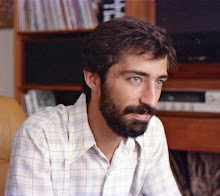
I took this photo of my friend, 
Gary Hodges, in L.A. in 1974. 
A review of Stealers Wheel
first album, May 24th, 1973.
Joe Egan and Gerry Rafferty
discuss the band and the 
release of their second album.
September 1st, 1973
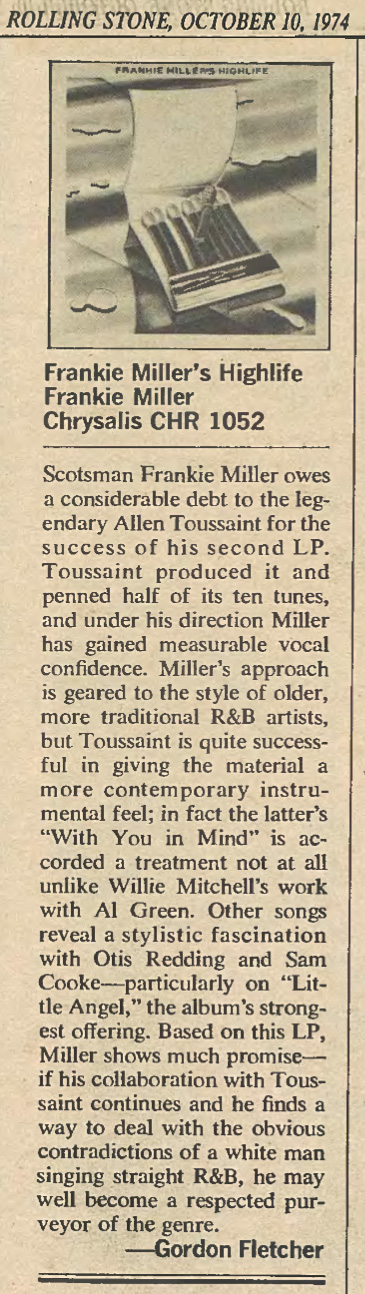
Gerry's first solo album,
"Can I Have My Money Back",
is finally released in the 
US and is reviewed 
November 22nd, 1973.
Rafferty and Egan are 
interviewed. They discuss
SW's second album and 
how the late release of
Gerry's first solo album
caused some to believe he 
had left the band.
February 14th, 1974.
An ad for the re-release
of early Humblebums songs and 
"Can I Have My Money Back"
May 4th, 1974.
Gerry discusses his career 
in depth, August 24, 1978.
Gerry discusses his image,
August 23rd, 1979.
An obituary,
January 4th, 2011

These are some of the 
albums in my collection.

The beautiful cover art on many of these albums
is by John Byrne. He signed his work, "Patrick".
The Humblebums were Billy Connolly
and Gerry Rafferty. They recorded two albums.
After The Humblebums split, Gerry Rafferty
recorded his first solo album.
The first Stealers Wheel album.
Their second album.
Their third, and last, album.
"City To City", Gerry's first solo album after 
Stealers Wheel, had his biggest hit, 
"Baker Street"
Gerry's second solo album.
His third solo album.

Some Related Links

Bert Jansch - A Memorial

BERT JANSCH: HUMBLE ALCHEMIST OF THE GUITAR
by Michael Collins Morton

Bert Jansch (1943 - 2011), the Scottish guitarist known for his work with The Pentangle and also for his standout work as a single performer, was generally acknowledged as one of the major figures in folk music during his lifetime. His rich style was derived from varied sources, but the fundamental integrity of his own talent always was uppermost in his music. In both his performances and his recordings, he gave the frequent and unmistakable impression that he played the guitar not merely for money or to dazzle his listeners, but mainly for the pure and private joy that it brought to him.

Although he wore his fame lightly and never displayed any interest in being a superstar, his musical reputation carried a serous weight. From Donovan (who wrote two songs in honor of him, "Bert's Blues" and "House of Jansch") to Jimmy Page (who transformed Bert's rendering of "Blackwaterside" into "Black Mountain Side," a track on the first album by Led Zeppelin) to Johnny Marr (who described him as "an incredible musician, totally uncompromising as a person and as an artist"), well-known guitarists of several generations praised his deft touch on the strings and dutifully looked to him for guidance. Over more than four decades, his forthright music came to represent a studious honesty that stood on its own.

Bert Jansch was born in Glasgow and grew up in Edinburgh. He took up the guitar as a teenager, learning quickly and steeping himself in the venerable traditions of folk music, and established a close friendship with another Scottish musician, Robin Williamson, who later founded The Incredible String Band. In the early 1960s, Bert Jansch began to perform in clubs throughout the United Kingdom. He also became friendly with a singer from Nottinghamshire, Anne Briggs, who acquainted him with folk songs that had a strong effect on his musical direction. His first two albums, Bert Jansch and It Don't Bother Me, were released in 1965. Bert Jansch included one of his most famous compositions, "Needle of Death," a song that he wrote after one of his friends was killed by an overdose of heroin.

In 1966, Bert Jansch recorded Jack Orion, his third album, and Bert and John, an album that featured him playing his guitar alongside John Renbourn, an English guitarist. Shortly after, the two guitarists joined with Jacqui McShee (vocals), Danny Thompson (double bass), and Terry Cox (drums) to form The Pentangle. In May of 1967, The Pentangle made their first appearance in public at the Royal Festival Hall in London. Their first album, The Pentangle, was released in 1968, and featured a heady mixture of diverse elements, with the guitar and voice of Bert Jansch providing repeated highlights. The Pentangle was followed by Sweet Child (1968), Basket of Light (1969), Cruel Sister (1970), Reflection (1971), and Solomon's Seal (1972). During the same period, Bert Jansch released four more albums on his own: Nicola (1967), Birthday Blues (1969), Rosemary Lane (1971), and Moonshine (1973).

When The Pentangle broke up at the beginning of 1973, Bert Jansch moved to a farm in Wales, seeking relief from the stress of constantly being on tour. He continued to record on his own, releasing L.A. Turnaround in 1974 and Santa Barbara Honeymoon in 1975. Both albums offered a venturesome departure from his earlier approach, and featured a hardy sound that leaned toward country rock. In 1982, the five members of The Pentangle joined together again for a performance at the Cambridge Folk Festival in Cherry Hinton, England, and then undertook a tour of Europe. When John Renbourn and other members later quit the band, Bert Jansch and Jacqui McShee persevered with The Pentangle, but in the late 1980s, Bert Jansch began to experience harmful effects from his many years of heavy drinking. As a result, he chose to stop his heedless intake of alcohol.

In his later years, even as his health continued to falter, he maintained a busy schedule, performing and recording to the best of his considerable abilities. His final album, The Black Swan, was released in 2006. He toured America with Neil Young in 2010, and performed with The Pentangle in England during the summer of 2011. To the end of his life, Bert Jansch remained a musician of unquestioned devotion and understated stature: a humble alchemist of the guitar, steadfastly creating tunes of lasting magic.


----------------------------------------------------------


A review of the first Pentangle 
album, October 26, 1968
A review of "Lucky 
Thirteen", March 1, 1969
An interview with Bert,
June 29, 1974.
A review of "L.A. Turnaround" 
album, September 14, 1974.
An article from Folk Roots, March 1994.
It includes a short interview with John Renbourn.
A review of Bert's 
last album, "The 
Black Swan".

Below is a an article by my friend, Gary Hodges.
When I informed him of Bert Jansch's 
death he was saddened and offered to 
write some personal thoughts. 
My thanks for his heartfelt efforts.

Below are albums in my collection.

The First Pentangle Album